


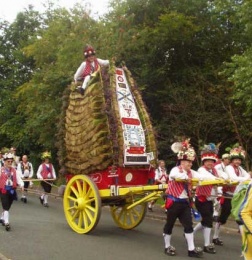
 A few teams have recreated the Rushcart tradition, most notably and successfully Saddleworth Morris Men. Rushes have had many uses: to form a warm carpet on earth and other rough floors; the rush pith forms a cheap and easily obtained wick for the "rush-light", and Cornish miners once used them to make fuzes; rushes were used to make bedding, mats (hassocks), seats for chairs, ropes, also cheese wraps, fish nets, and the pith for stuffing parts of clothing. Even a charm for warts or a ring to delude naive young women "A custom extremely hurtful to the interests of morality, appears anciently to have prevailed both in England and other countries, of marrying with a Rush-Ring. It was chiefly practised, however by designing men, for the purpose of debauching their mistresses, who were sometimes so infatuated as to believe that this mock ceremony was a real marriage" (Brand's Popular Antiquities).
Rush-Bearing
The strewing of rushes on house and church floors largely died out in the early 1800s. The purpose of the rushes was to provide warmth for the earthen and flag floors. They were replaced occasionally, with little thought given to cleanliness. Sometimes the house rushes were changed regularly, but more often they could be left for years "As to the floors, they are usually made of clay, covered with rushes that grow in the fens, which are so slightly removed now and then that the lower part remains sometimes for twenty years together, and in it a collection of filthyness not to be named". Erasmus at the time of Henry VIII. From William the Conquerer to Elizabeth the First, the palace floors were covered by rushes.
In churches seats were not provided until the fifteenth century, wooden floors were rare, kneeling was very uncomfortable and since only the gentry could afford cushions, rushes were used as a floor covering. It is in this context that a custom arose for the replacement of rushes strewn on church floors. In Lancashire the rush replacement developed alongside of the wakes religious celebrations or the feast of dedication of the church, becoming a festival and an excuse for singing, drinking and dancing - and fighting. A parish party!
Women pulling Rushcarts in Rochdale
One of the very few references to women pulling rushcarts: in the 1618, King James's 'Book of Sports' there is the statement: May games, Whitsun ales, Morris dances and the setting up of Maypoles and other sports, ... so that the game may be had in due and convenient time without impediment or neglect of divine service, and that the women shall have leave to carry rushes to church for the decorating of it. However by the 1800's rushcarts had supplanted the women's role. Men generally built up the rushcarts, and men usually pulled the carts - with one or two exceptions. It is possible that the complete takeover by men of the collection of rushes put an end to the Mayday style frolics. In 1859, however, the Smallbridge Rushcart shocked even the Vicar. As the Rochdale Observer put it, in a piece of calm and uncritical reporting: the Smallbridge cart was "...partly manned by women and girls - 42 females helping to drag the cart". Letters to the newspaper following the event bordered on the hysterical, John Ashworth, who founded the Chapel for the Destitute, wrote: "Those persons labouring for the redemption of mankind must be sick at heart. Never could they have conceived that young girls would be seen drawing rushcarts."
Revival of Rush-bearing ceremonies
 In recent years a number of other rush-bearing ceremonies have been revived. The picture shows the Littleborough cart.
- Sowerby Bridge - re-started in 1977. Earlier ceremonies, 1886, 1906 are mentioned on their web site.
- In Cumbria - churches at Grasmere, Ambleside (see mural in the church), Warcop, Great Musgrave and Urswick all have rushbearing Ceremonies.
- Lymm - Warrington. Thelwall Morris record that there are many records of rushbearings for the late 1800s. Thelwall Morris Men (plus a couple of guest dancers) dance at the Lymm Rushbearing every year: visit also Thelwall Morris web site for more photos and details of the Lymm dance.
- Gorton Morris Men, revived their rush-bearing ceremony in 1980. It ceased again in 1991 but was resurrected "one last time" in 2009 to celebrate the 100th year of Gorton becoming a part of Manchester.See 2009 Rush cart on Facebook
- Littleborough Rushbearing Festival - Littleborough Rushbearing was revived in 1991 by Rochdale Morris. The project was successfully achieved with the help of Littleborough Action Group and has become an important part of Littleborough’s calendar of events. It is now organised by LEAF in conjunction with Littleborough Oakenhoof Cloggers
- Newchurch - at the foot of Pendle Hill
- Whitworth rushcart; see 1910 'Old Whitworth'. The 1910 report also has a picture described as 'Britannia coconutters', however they are the Whitworth Nutters a totally different side. There is an article about the Whitworth Nutters in English Dance & Song, 1965, 27(5), 142-144. "Morris, Nutters and Rushcart in Whitworth" by Julian Pilling. The photograph also appears in Folklife, 1970, 8, 20-31. "Rushcarts of the North-west of England" by Alex Helm {Note by Duncan Broomhead}.
- Wingrave - a village in the Vale of Aylesbury, Buckinghamshire, midway between Leighton Buzzard and Aylesbury has a rush strewing ceremony. In 1986 they also employed a Morris Side, but the rushes were changed for hay back in the 1830s. 150 years of history with hay - as the accompanying picture shows! Duncan Broomhead did some detective work and found that the 1986 side were Aldbury Morris Men, for whom Chris Sissons comments:
 "At the front on the left is Ken Dingley (positive ID) The head coming out of Ken's armpit is the other Ken (Horwood) (positive ID) The tall bloke behind the two Kens is Chris Sissons (positive ID - well, I ought to know!). At the front on the right is Bryan Daniels (positive ID) The partly obscured head behind Bryan might be John Beeley (insufficient data for a positive ID). Coming up the middle on the left (looking at the picture) is Neil Freeman (fairly positive ID) Coming up the middle on the right? ..... I haven't got a clue."
St Mary Redcliffe, 'the finest parish church in all England', in Bristol, has Rush Sunday
-
"The Rush Sunday Service, instituted in 1493 by William Spenser; Mayor of Bristol,
takes its name from the rushes and herbs that are strewn on the floor." - At the Forest Chapel, St Stephens in Macclesfield Forest (Langley in the Pennines) there is an annual service held on the first Sunday after the 12th August, which celebrates the changing of the rushes.in Macclesfield Forest (Langley in the Pennines)
- At Newchurch-in-Pendle, in August, St Mary's celebrates an annual rushbearing ceremony, and still crowns a Rushbearing Queen.
- See also . "The Tommy Talker Bands of the West Riding" and the Doc Rowe Archive